
Article
Bebop Scales on Guitar: How to Add Chromatic Passing Tones to Your Lines
Master bebop scales for guitar. Learn dominant, major, minor, and half-diminished bebop scales with fingerings and practice exercises.
Popular fretboard positions with fingering suggestions
Showing 8 of 66 playable shapes
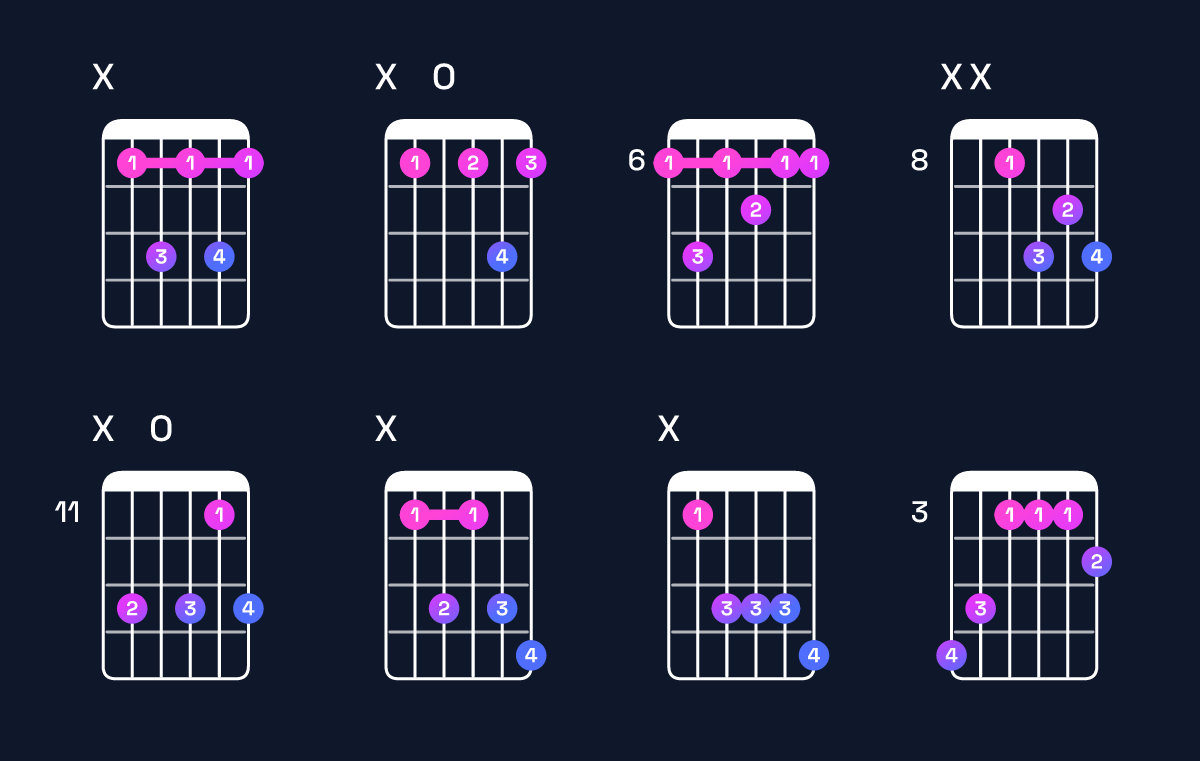
The B♭ dominant 7th dominant 7th chord, formed by adding a minor seventh A♭ to the major triad, creates tension that seeks resolution, typically to the tonic. The combination of the major third D and minor seventh A♭ provides a bluesy, soulful feel, making it essential in jazz, blues, and classical cadences.
Each note below shows how the chord is built from its root. This is the theory layer underneath the fretboard shapes.
The root anchors the chord and defines its tonal center.
This note defines the chord's major quality and brings brightness to the sound.
The fifth reinforces stability and gives the chord its strong harmonic frame.
The minor seventh adds bluesy or jazzy tension that wants to move onward.
Articles that reference this chord and explain how to use it in your playing.
Master bebop scales for guitar. Learn dominant, major, minor, and half-diminished bebop scales with fingerings and practice exercises.
Master chord stabs and muted accents for funk, soul, and rock rhythms with tight articulation techniques.
Master guitar chord progressions in the key of Bb. Learn the diatonic chords, practical barre chord tips, and progressions used in popular songs.
Learn guitar chord progressions in the key of Eb major. Master diatonic chords, flat key navigation, and songs in Eb with practical tips.
Learn the essential jazz chord progressions on guitar, including the ii-V-I, turnarounds, and rhythm changes. Includes voicings, theory, and practice exercises.
Learn jazz guitar comping - the art of accompanying other musicians with rhythmic chord hits, syncopation, and dynamic voicings. Includes patterns, tips, and common voicings.