
Article
How to Adapt Piano Chords and Sheet Music for Guitar
Learn practical techniques for translating piano voicings, chord symbols, and sheet music to guitar. Master wide voicings, complex chords, and keyboard arrangements.
Popular fretboard positions with fingering suggestions
Showing 8 of 80 playable shapes
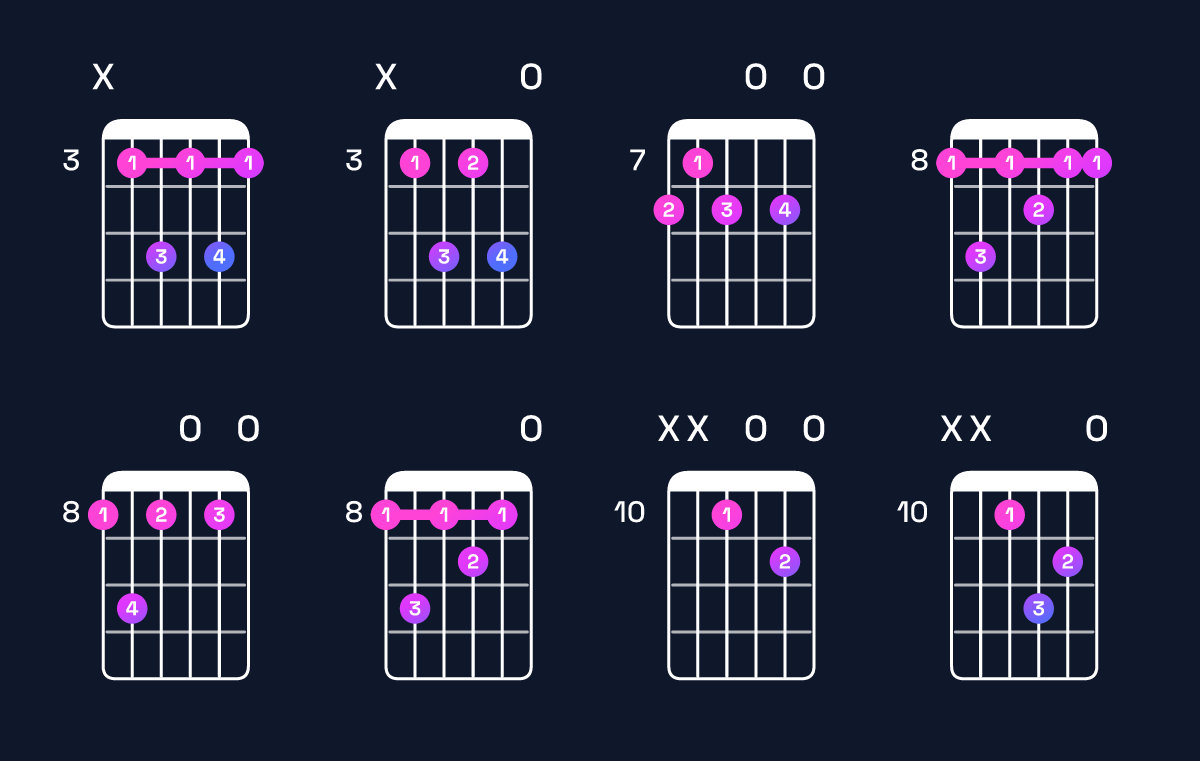
The C dominant 7th dominant 7th chord, formed by adding a minor seventh B♭ to the major triad, creates tension that seeks resolution, typically to the tonic. The combination of the major third E and minor seventh B♭ provides a bluesy, soulful feel, making it essential in jazz, blues, and classical cadences.
Each note below shows how the chord is built from its root. This is the theory layer underneath the fretboard shapes.
The root anchors the chord and defines its tonal center.
This note defines the chord's major quality and brings brightness to the sound.
The fifth reinforces stability and gives the chord its strong harmonic frame.
The minor seventh adds bluesy or jazzy tension that wants to move onward.
Articles that reference this chord and explain how to use it in your playing.
Learn practical techniques for translating piano voicings, chord symbols, and sheet music to guitar. Master wide voicings, complex chords, and keyboard arrangements.
Learn augmented chords on guitar - shapes, theory, and creative uses. These bright, tense chords add color and sophistication to your playing.
Master bebop scales for guitar. Learn dominant, major, minor, and half-diminished bebop scales with fingerings and practice exercises.
Master the 12-bar blues and its variations on guitar. Includes dominant 7th voicings, turnarounds, shuffle rhythms, and tips for authentic blues feel.
Learn bossa nova guitar chords, rhythm patterns, and fingerstyle techniques to master this Brazilian sound.
Learn chord construction step-by-step: intervals, triads, sevenths, and extensions. Build any chord from theory to fretboard.